Reference
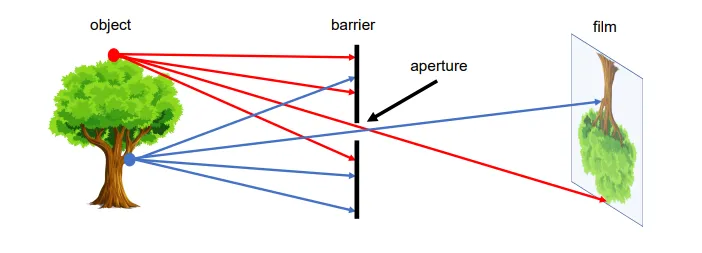
Figure 1. A simple working camera model: the pinhole camera model
Quote
Without a barrier in place, every point on the film will be influenced by light rays emitted from every point on the 3D object. Due to the barrier, only one (or a few) of these rays of light passes through the aperture (구멍) and hits the film.
이것이 one-to-one mapping between 3D point on the object and the film 을 가능케 하고 이 모델을 pinhole camera model 이라고 함.
Figure 2. A formal construction of the pinhole camera model
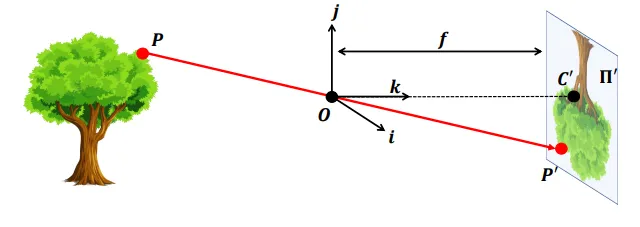
film = image or retinal plane Aperture = pinhole (=point O) or center of the camera distance between the image plane and the pinhole O = focal length point on some point on the 3D object point (= point P projected on the image) = point = point C projected on the image plane camera reference system (or camera coordinate system) = = optical axis
triangle 는 triangle , , and 와 유사하다. 그러므로 law of similar triangles 를 적용하면 그러므로, (= focal length) 는 pinhole camera 에서는 이다.
Figure 3. The effects of aperture size on the image.

위의 사진은 Aperture 크기에 따른 image 의 변화이다. Aperture 가 커질수록 통과시키는 light rays 들의 수가 많아지고 사진에 blur 를 일으키는 모습이다. Aperture 가 작을때는 선명해지지만 들어오는 빛이 적어 어둡게 나온다. 우리는 선명하고 (crisp) 밝은 (bright) 한 이미지를 원하지만 pinhole camera model 은 이것을 불가능케 한다. 하지만 이 문제를 렌즈로 해결할 수 있다.