Reference
Abstract
PROgressive SAmple Consensus 대표적인 RANSAC 개선안 중 하나. 모든 데이터를 무작위로 뽑는 대신, 데이터의 품질 (quality) 이 높은 것부터 우선적으로 샘플링. PROSAC의 장점: 압도적인 속도 향상 (수십 ~ 수백배), 효율성 SLAM 에서 필수적으로 고려되는 알고리즘
Quote
In fact, PROSAC is designed to draw the same samples as RANSAC, only in a different order. RANSAC: Treats all correspondences equally PROSAC: only computes the random samples (a subset of data with the highest quality)
Notation
The set of data points, The data points in are sorted in descending order with respect to the quality function
Quality-based Sampling
, where is the sequence of the same samples sorted in descending order according to the sample quality
: an average number of samples from contain data points The recurrent relation for is,
Quote
defines after how many samples the behavior of PROSAC and RANSAC becomes identical. In our experiment, the parameter was set to .
처음에는 가장 신뢰도가 높은 상위 개의 데이터에서만 샘플을 뽑음. 시간이 지남에 따라 (반복 횟수가 늘어남에 따라) 고려하는 데이터의 범위 을 점진적으로 확장하여 최종적으로는 전체 데이터셋 에 도달.
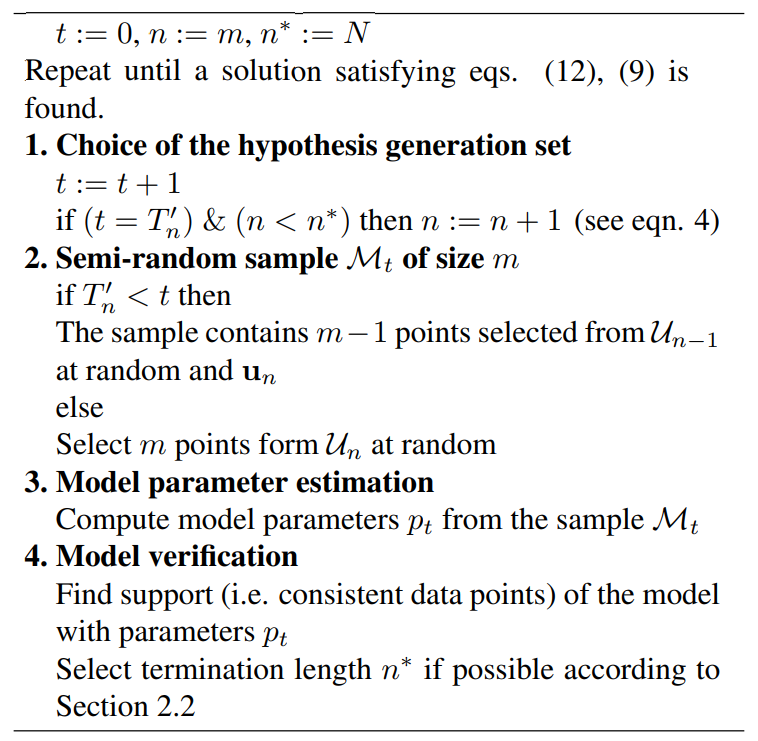
- 초기화: (최소 샘플 수), .
- 조건 확인: 만약 현재 반복 횟수 가 에 도달하고 이면, 을 1 증가 ()
- 샘플링 전략
- 항상 최신으로 포함된 데이터 은 반드시 포함시킴.
- 나머지 개의 샘플은 상위 개의 데이터 중에서 무작위로 뽑음. 이는 새로 확장된 범위의 데이터가 모델 후보에 즉시 반영되도록 하기 위함.
The Growth Function
In PROSAC, the -th sample consists of PROSAC 의 핵심은 반복 횟수 에 따라 샘플링 범위 을 결정하는 함수 를 설계하는 것. 여기서 는 상위 개의 데이터 내에서 적어도 하나의 유효한 샘플을 뽑기 위해 필요한 평균 시도 횟수.
Stopping Criterion
- non-randomness
- maximality 은 아직 제대로 이해하지 못하겠다. 나중에 이해하면 마저 작성하겠음.